

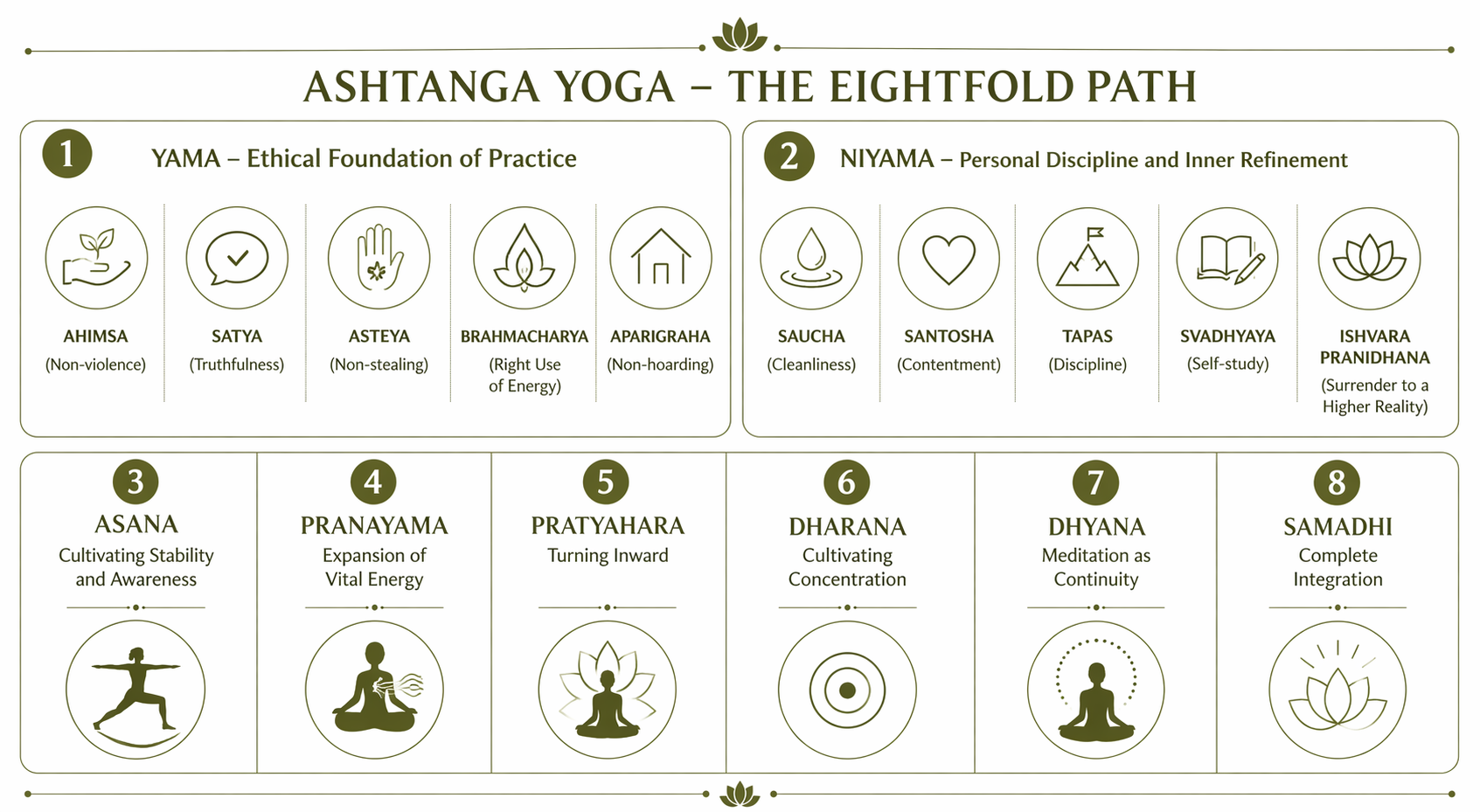
Yoga, as presented by Sage Patanjali in the Yoga Sutras of Patanjali, is a deeply structured and intelligent system for inner transformation. It is not limited to physical practice but offers a complete path for the evolution of body, mind, and consciousness.
The teaching of the Eightfold Path (Ashtanga Yoga) is described in Chapter 2 (Sadhana Pada), Sutras 29–55, where Sage Patanjali lays out a systematic approach to self-development.
This path is not a ladder to climb step by step, but an integrated system where all eight limbs support and refine each other simultaneously. Through consistent practice, one gradually moves from external awareness to deeper inner stillness.
1. Yama – Ethical Foundation of Practice
Yama establishes how we relate to the world, but more importantly, how we relate to ourselves within the practice. It is not separate from asana; rather, it directly shapes the quality of how we practice.
Ahimsa (Non-violence)
Ahimsa begins in the body. In asana, it is expressed as non-aggression toward one’s own limitations. Forcing, pushing, or competing with the body is a subtle form of violence. When ahimsa is present, the practitioner develops sensitivity, patience, and respect for the body’s current condition.
Satya (Truthfulness)
Satya in practice means honesty in observation. It is the ability to see clearly: where the body is stiff, where it compensates, where the breath is disturbed. Without satya, practice becomes imitation or performance rather than learning.
Asteya (Non-stealing)
Asteya extends beyond material things. In asana, it means not trying to take a result that the body is not yet prepared for. Rushing into advanced postures without the necessary foundation is a form of stealing from the process.
Brahmacharya (Right Use of Energy)
Traditionally interpreted as moderation, here it can be understood as cultivating the qualities associated with a refined state of mind.
maitri (friendliness), karuna (compassion), mudita (joy), and upeksha (equanimity), which are the four bhāvas described in Yoga philosophy (Yoga Sutra 1.33). While not a literal definition of brahmacharya, they beautifully express the direction of inner refinement.
In practice, brahmacharya can be understood as:
- Conserving and channeling energy wisely
- Practicing with steadiness rather than excess
- Allowing the mind to develop qualities like friendliness and balance
Aparigraha (Non-hoarding)
In asana, this is the ability to let go of expectations, achievements, and attachment to outcomes. Each practice becomes fresh, rather than driven by accumulation of past experiences or goals.
2. Niyama – Personal Discipline and Inner Refinement
If Yama is how we relate outwardly, Niyama is how we cultivate our inner environment. These are directly observable within daily practice.
Saucha (Cleanliness)
Beyond physical cleanliness, saucha in practice refers to clarity in movement, breath, and alignment. A clean practice is one where unnecessary effort and confusion are reduced.
Santosha (Contentment)
Santosha is not passivity but acceptance of the present condition without agitation. In asana, it is the ability to remain steady even when the posture is challenging, without frustration or comparison.
Tapas (Discipline)
Tapas is the consistent effort that transforms the body and mind. It is the willingness to stay with the practice regularly, even when it is demanding, without seeking comfort at every step.
Svadhyaya (Self-study)
This is one of the most direct connections to asana. Each posture becomes a tool for observation:
- How does the body respond?
- Where does the mind wander?
- How does the breath change?
Through this, practice becomes a study of oneself rather than a repetition of shapes.
Ishvara Pranidhana (Surrender to a Higher Reality)
Ishvara Pranidhana refers to the conscious surrender of the individual ego to a higher intelligence or universal order. In the context of yoga, this does not necessarily imply a religious belief, but rather an understanding that there is a force beyond personal control that governs life.
In practice, this principle is expressed as:
- Letting go of the constant need to control outcomes
- Releasing attachment to success or failure in practice
- Allowing effort to be balanced with humility and acceptance
Within asana, Ishvara Pranidhana becomes visible when the practitioner moves from doing the posture to allowing the posture to unfold. There is effort, but not aggression; intention, but not ego-driven force.
3. Asana – Cultivating Stability and Awareness
Asana, as defined by Patanjali (Sutra 2.46), is “Sthira Sukham Asanam” – a posture that is steady and comfortable.
This definition shifts the focus from external form to internal experience:
- Stability creates physical and mental grounding
- Comfort allows the breath and mind to settle
- Alignment becomes a means to develop intelligence in the body
In this way, asana becomes a preparation for deeper practices, not an end in itself.
4. Pranayama – Expansion of Vital Energy
Pranayama is introduced after asana for a reason. The body must first develop:
- Stability
- Sensitivity
- Structural alignment
Only then can breath be refined safely.
Pranayama is not merely breath control. It is the expansion and regulation of life force through breath, requiring:
- Awareness
- Precision
- Gradual progression
Improper practice can create disturbance, which is why it must be approached with care and preparation.
5. Pratyahara – Turning Inward
Pratyahara is the withdrawal of the senses from external objects.
Rather than suppressing the senses, it is the development of:
- Inner steadiness
- Reduced dependency on external stimulation
- Ability to remain centered regardless of surroundings
This marks a significant transition from outer practice to inner awareness.
6. Dharana – Cultivating Concentration
Dharana is the intentional fixing of attention on a chosen point.
In earlier stages, the mind is scattered. Through dharana:
- Attention is trained to stay
- Distractions are reduced
- Mental discipline is developed
This is not forced concentration, but cultivated through consistent practice.
7. Dhyana – Meditation as Continuity
Dhyana arises when concentration becomes effortless and continuous.
There is:
- A steady flow of awareness
- Minimal interruption
- Deepening stillness
Meditation is not something imposed, but something that naturally emerges when the mind becomes refined.
8. Samadhi – Complete Integration
Samadhi is the culmination of the practice, where:
- The distinction between observer and observed dissolves
- The mind becomes completely absorbed
- There is a state of profound clarity and stillness
It represents not an escape, but a complete integration of being.
Closing Insight
The Eightfold Path is not a theoretical model, but a living process of evolution. Each limb supports the others, and even the most basic physical practice can become a gateway to deeper awareness when approached with the right understanding.
At Deep on Yog, this path is approached through:
- Precision and alignment
- Use of props for accessibility and depth
- Gradual and structured progression
- Awareness as the central element of practice
This allows yoga to unfold not as a quick achievement, but as a sustained and meaningful journey.