
If you have been practicing yoga at home, or thinking about joining an online yoga class, there is a good chance you have wondered whether it is possible to learn properly without a teacher physically in the room. Whether alignment can really be corrected over a screen. Whether you need a room full of equipment. Whether online group classes are just a compromise you make when nothing else is available.
This guide answers all of that. It covers how to set up a genuine yoga practice at home, how to use everyday household objects as props, how a well-structured online class actually works, and how yoga practiced correctly affects not just your muscles but your entire body system including your doshas, your five elements, and the deeper layers described in classical Indian philosophy.
Part 1: What Good Yoga Instruction Actually Looks Like
Before anything else, it helps to understand what separates a well-taught yoga class from a generic one, whether online or offline.
Most fitness-oriented yoga classes focus on getting you through a sequence. The instruction is general: “raise your arms,” “fold forward,” “hold for five breaths.” This works at a surface level but it does not teach you anything about your own body, and over time it can reinforce the same postural habits and muscular imbalances you brought into the class in the first place.
Alignment-based yoga, rooted in the tradition developed by B.K.S. Iyengar, works differently. Every pose is approached as an opportunity to understand how the body should ideally be organized in space. The teacher is not just leading a sequence but observing each student, noticing what is happening in the joints, the spine, the breath, and offering corrections that are specific to that individual.
This kind of teaching asks more from both the teacher and the student. But the results are different too. Students who learn this way develop body awareness that stays with them. They begin to understand why a pose feels uncomfortable, not just that it does. They learn how to use their bodies more intelligently in everyday life, not just on the mat.
What a Teacher Is Actually Watching
When a trained teacher observes a student in a pose, they are looking at several things at once:
Spinal alignment: Is the natural curve of the spine being maintained or compressed? Is there excessive rounding in the thoracic spine? Is the lumbar spine collapsing or overarching?
Joint positioning: Are the knees tracking correctly over the toes? Is there hyperextension in the elbows or knees? Are the hip joints moving freely or being forced?
Weight distribution: Is the student bearing weight evenly through both feet? Is one side of the pelvis dropping? Is the body compensating for tightness somewhere by shifting weight somewhere else?
Muscle engagement: Which muscles are working and which are passive when they should not be? Are the core muscles supporting the spine or is the student hanging on their joints?
Breath: Is the breath free and steady or held and restricted? Does the chest move when it should be relatively still? Is the belly overly tight?
Facial tension: This is often overlooked, but the face reflects the nervous system. A clenched jaw or furrowed brow tells a teacher that the student is working too hard and needs to be brought back to ease.
All of these things are observable. In an online setting, a camera actually gives a teacher a direct, unobstructed view of the student, sometimes clearer than in a crowded studio where other students are in the way.
Part 2: How Online Yoga Classes Can Be Genuinely Precise
The assumption that online yoga must be vague or imprecise comes from experience with poorly run online classes, not from the format itself. When a teacher is trained to observe carefully and communicate precisely through verbal instruction, an online class can be remarkably specific.
Verbal Cueing as a Teaching Tool
In person, a teacher can use touch to help a student feel where a correction needs to happen. Online, that tool is unavailable. But this limitation, approached well, becomes an advantage for the student.
When a teacher cannot touch you, they must describe the correction in a way that helps you find it yourself. “Feel the inner edge of your left foot pressing down” or “draw the outer hip of your back leg toward the floor” or “without moving your arm, feel as if the shoulder blade is moving away from the spine.” This kind of instruction teaches proprioception, which is the ability to sense where your body is in space without looking at it.
Students who learn through precise verbal instruction develop a much stronger internal map of their body than students who have always been adjusted physically. They become independent practitioners faster.
Watching in Real Time
A good online teacher is watching every student on screen throughout the class, not just demonstrating poses. They notice if your weight has shifted, if your knee has collapsed, if your head has dropped forward. They call out corrections by name, which in a group class also benefits the other students who may have the same pattern without realizing it.
Over several classes, a teacher builds a picture of each student’s specific tendencies. This carries forward. The corrections become more targeted. The sequencing can be adjusted based on what the group needs.
The Benefit of Practicing in Your Own Space
There is something genuinely useful about learning yoga in the environment where you actually live. You are not performing for a studio. Your habitual patterns are more visible because you are in your habitual environment. The teacher can see how you naturally stand, how you set up your mat, how you transition between poses without the self-consciousness that sometimes comes in a group studio setting.
Part 3: Household Objects as Yoga Props
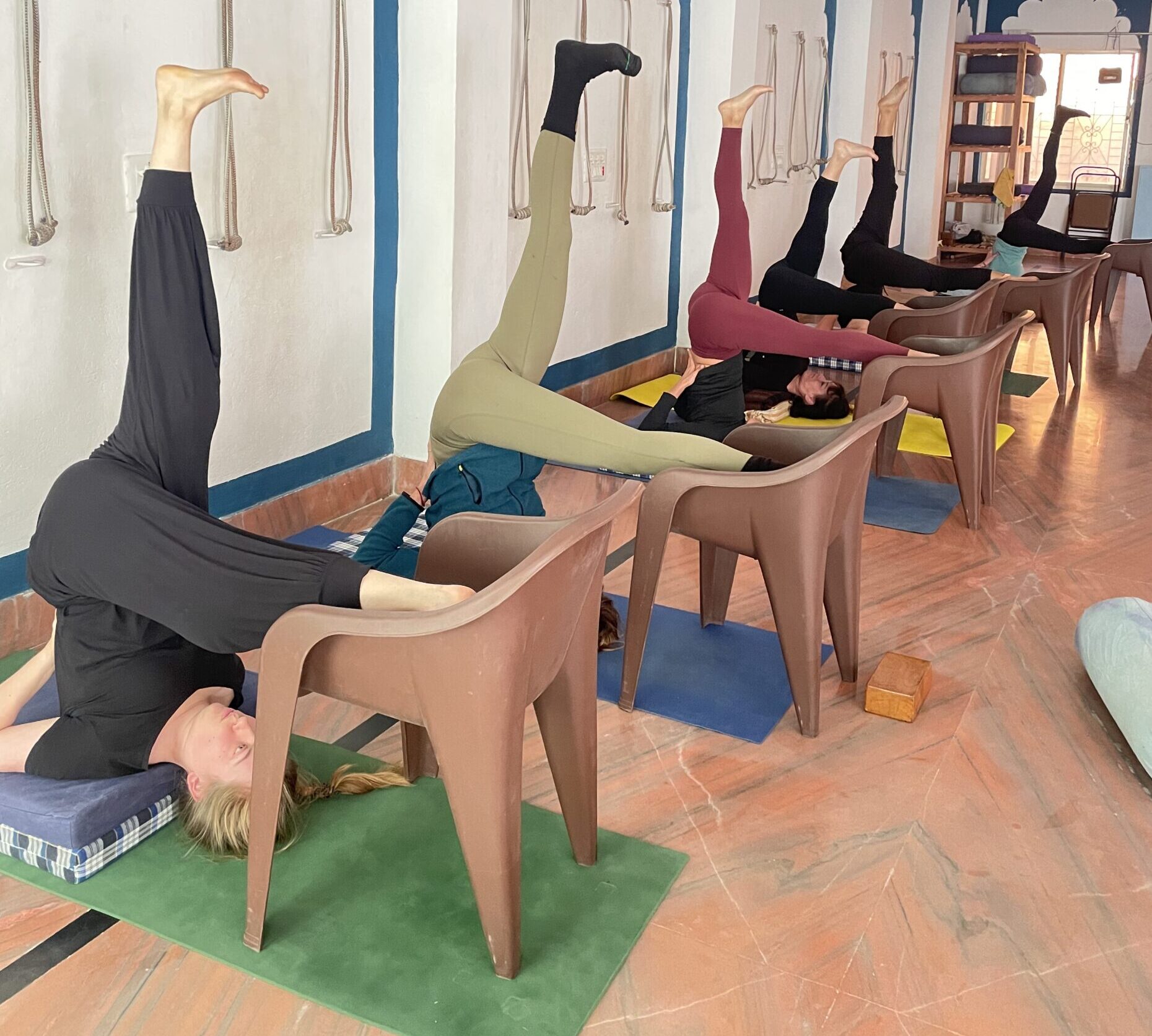
Props are central to alignment-based yoga. They are not for beginners only or for people who cannot do the “full” pose. They are tools that change the quality of a pose for any practitioner. A prop can make a pose more accessible, more precise, safer, or deeper depending on how it is used.
You do not need to buy anything to practice with props. Your home already has everything you need.
The Wall
The wall is the most underrated prop in yoga. It provides:
Feedback for alignment: Standing with your back against the wall in Tadasana (mountain pose) immediately shows you whether your lower back is arching, whether your shoulders are rounding, whether your head is jutting forward. The wall gives you honest information that your proprioception alone may miss.
Support for balance poses: In poses like Vrksasana (tree pose) or Virabhadrasana III (warrior III), a fingertip on the wall removes the anxiety of falling and allows you to focus on the actual alignment of the pose.
Resistance for strengthening: Pressing the palms into the wall in a standing forward lean engages the shoulder girdle in a way that is difficult to achieve otherwise.
Support for inversions: Legs up the wall (Viparita Karani) is one of the most restorative poses in yoga and requires nothing except a wall and a blanket.
A Sturdy Chair
A dining chair without armrests, or even with them, is useful in many ways:
- The seat of the chair can be used as a support in standing forward bends for students with tight hamstrings or lower back sensitivity
- The back of the chair can be held for balance in standing poses
- Sitting on the edge of a chair and folding forward trains the action of the forward bend with the pelvis tilting correctly rather than the lower back rounding
- The chair can support the hands in gentle backbend preparations
- For students who cannot sit comfortably on the floor, chair-based poses make pranayama and meditation accessible
Books, Folded Blankets, or Firm Cushions
A stack of thick books or a few folded blankets can substitute for a yoga block in most situations:
- Under the hands in standing forward bends when the floor is too far
- Under the sitting bones in seated poses to tilt the pelvis forward and release the lower back
- Supporting the head in supine poses to avoid neck strain
- Under the knees in Savasana to release lumbar tension
- Between the thighs in poses where internal rotation of the legs needs to be activated
The firmness matters. A soft pillow does not give the same feedback as a folded blanket or a hardcover book.
A Belt, Dupatta, or Long Scarf
A yoga strap is simply a length of material with some resistance. A dupatta, a neckties, a dressing gown belt, or any similar object works well:
- In Supta Padangusthasana (supine hand to foot pose), a strap around the foot allows you to extend the leg fully without straining the hamstring attachment
- In seated forward bends, looping the strap around the feet allows students with tight hamstrings to maintain a long spine instead of collapsing the back to reach the feet
- In shoulder openers, holding the strap behind the back with both hands and working the hands closer together over time develops shoulder mobility safely
A Rolled Blanket or Firm Bolster
A tightly rolled blanket placed under the ankles, knees, or lower back changes the geometry of a pose significantly:
- Under the knees in a supine position releases the psoas and lumbar spine
- Under the chest in prone backbends lifts the ribcage and reduces compression in the lower back
- Between the shoulder blades in a supported backbend opens the thoracic spine gently
- Supporting the hips in forward bends allows the pelvis to tilt without strain
Part 4: How Yoga Works on the Whole Body System
Understanding yoga only as physical exercise misses most of what it actually does. A well-structured practice works on several interconnected systems simultaneously.
The Muscular and Fascial System
The obvious layer. Yoga lengthens shortened muscles and strengthens weak ones, which is why it helps with postural problems, back pain, and general stiffness. But the fascial system, which is the connective tissue that wraps every muscle, organ, and bone in the body, responds to yoga in ways that straightforward stretching does not address.
Fascia responds to slow, sustained holds rather than quick dynamic stretches. It also responds to direction of force. This is why alignment matters: the same stretch applied in a slightly different direction reaches a different part of the fascial network. Iyengar-style teaching, with its attention to the precise positioning of limbs and joints, works directly with this.
The Nervous System
Many people come to yoga carrying chronic tension in the nervous system. The body is in a low-grade state of alertness, the breath is shallow, the muscles around the neck and shoulders are never fully at rest. This is the physiological signature of chronic stress.
Slow yoga with conscious breathing directly addresses this. The extended exhale activates the parasympathetic nervous system, which is the rest and digest branch that counteracts the stress response. Inversions, even gentle ones like legs up the wall, shift blood flow and calm the nervous system. Savasana, practiced properly, trains the nervous system to enter genuine rest.
The Doshas: Vata, Pitta, and Kapha
In the Ayurvedic framework, the body is governed by three fundamental energies or doshas: Vata (air and space), Pitta (fire and water), and Kapha (earth and water). Each person has a unique constitution, and imbalances in the doshas manifest as specific physical and mental patterns.
A thoughtfully designed yoga practice can work to bring these into balance:
For Vata imbalance (characterized by anxiety, restlessness, dryness, disturbed sleep, and irregular digestion): grounding, slow, repetitive practices are most beneficial. Long holds in standing poses, forward bends, and restorative poses calm the excess movement of Vata. Warm, rhythmic breathing like Nadi Shodhana is helpful.
For Pitta imbalance (characterized by inflammation, irritability, overheating, excessive drive, and skin issues): cooling and surrendering practices are needed. Supported forward bends, gentle twists, and calming inversions reduce Pitta heat. Sheetali pranayama (cooling breath) is specifically indicated.
For Kapha imbalance (characterized by heaviness, lethargy, congestion, weight gain, and emotional attachment): energizing, warming practices that build heat and move stagnation are most useful. Dynamic standing sequences, backbends, and Kapalabhati pranayama activate the system and move excess Kapha.
Most people have a dominant dosha and a secondary one. A good yoga teacher considers this when designing a practice, particularly for therapeutic work.
The Five Elements and the Body
Classical Indian thought describes the material world through five elements: earth (prithvi), water (jal), fire (agni), air (vayu), and space (akasha). These are not meant literally but as qualities that manifest in both the body and mind.
In yoga practice, these elements are engaged and balanced through different types of work:
Earth is accessed through weight-bearing, stability, and groundedness. Standing poses that require you to feel your feet fully connected to the floor, that ask you to find steadiness before movement, work with the earth element. This is why a good standing pose practice often leaves people feeling more settled and less anxious.
Water relates to fluidity, circulation, and the emotional body. Hip-opening poses, lateral movements, and gentle flowing sequences work with the water element. The lymphatic system, which has no pump of its own and relies on movement to circulate, is activated by the full range of motion that yoga provides.
Fire is the element of transformation, digestion, and energy. Twisting poses compress and release the abdominal organs, stimulating digestive function. Core work builds agni, the digestive fire. Kapalabhati pranayama directly fans this fire.
Air is breath, prana, and the nervous system. All pranayama work is fundamentally working with the air element. The quality of the breath reflects the quality of the air element in the body.
Space is the subtlest element, associated with consciousness, stillness, and the experience of meditation. It cannot be created through effort but emerges when the other elements are in balance. This is why the stillness at the end of a good practice, in Savasana or in seated meditation, feels qualitatively different from just lying down.
The Panchakosha Framework
The Taittiriya Upanishad describes the human being as existing in five layers or sheaths, each nested within the other:
Annamaya Kosha is the physical body, sustained by food. The asana practice primarily addresses this layer, working on the bones, muscles, joints, and organs.
Pranamaya Kosha is the energy body, sustained by breath. Pranayama practice works on this layer. When the breath is irregular or restricted, this kosha is disturbed, and the disturbance moves inward to affect the mental and emotional layers.
Manomaya Kosha is the mental and emotional body, the layer of thoughts, feelings, and reactions. Sustained asana practice with breath awareness begins to affect this layer. Difficult emotions sometimes surface during practice. Savasana can bring unexpected emotional release.
Vijnanamaya Kosha is the layer of discernment and intelligence. This is the part of us that observes rather than reacts. Meditation practice develops this layer. Over time, the practitioner develops the capacity to witness mental and emotional patterns without being swept away by them.
Anandamaya Kosha is the bliss body, the deepest layer, closest to pure awareness. It is touched in deep meditation and in moments of complete stillness and absorption.
A complete yoga practice, one that includes asana, pranayama, and meditation, addresses all five koshas. This is why yoga practiced seriously feels different from any other form of exercise or stress management. It is not working on one system. It is working on the whole.
Part 5: Building a Sustainable Home Practice
All of the above is most useful when it becomes a consistent practice rather than something done occasionally. Here is how to approach that realistically.
Start with what you have. You do not need a special mat, specific clothing, or a dedicated room. A clean floor space, a wall, and the household objects described above are enough.
Practice at the same time each day. The body adapts to rhythms. Morning practice tends to be more activating and is good for standing poses and pranayama. Evening practice tends toward release and is better suited for restorative and gentle work. Both are valid.
Shorter and consistent beats longer and occasional. Thirty minutes every day does more than a two-hour session on weekends. The nervous system changes with repetition, not intensity.
Do not skip Savasana. It is not a reward for finishing the poses. It is the integration phase where the work of the practice settles into the body and nervous system. Five to ten minutes of genuine rest at the end of a practice is not optional.
Learn from a teacher, then practice on your own. A regular class gives you correct technique, feedback, and progression. A home practice between classes deepens what you have learned and makes it your own. Both together produce results that neither does alone.
How Deep On Yog Approaches All of This
Everything described in this guide forms the foundation of the online classes at Deep On Yog. The teaching is alignment-based, which means every class involves close observation of each student, precise verbal corrections, and the use of props, including everyday household objects, to support and deepen the practice.
Classes are kept intentionally small so that individual attention is possible even in a group setting. Students with back pain, cervical issues, postural problems, and restricted mobility are welcome and are given modifications appropriate to their condition. The practice integrates asana, pranayama, and elements of yoga philosophy so that students gradually develop a relationship with yoga that goes beyond physical exercise.
If you have questions or want to understand whether these classes are right for you, you can reach out directly at deeponyog@gmail.com or +91-82199-43989.
This guide was written for anyone curious about practicing yoga seriously at home, whether you are new to yoga or have been practicing for years and want to go deeper into what the practice is actually doing.